


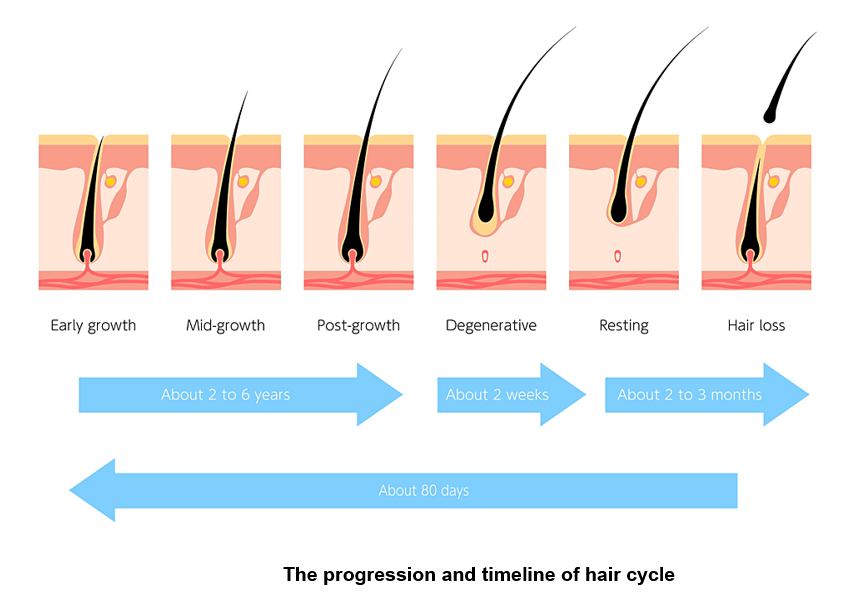
The science of hair loss is being investigated for decades. It is understood that up to 100 hair loss a day is perfectly normal. Any loss above this number with no replenishment however leads to eventual thinning of the hair. Male and female hair loss has multiple etiologies. Stressors such as bereavement leading to hair loss could lead to telogen effluvium. That under stressful conditions, cortisol secretion increases in humans. The presence of cortisol has been shown to decrease the activity of follicle stem cells located at the bottom of the hair follicle in a niche called bulge. This bulge location is positioned between the arrector pili muscle and the opening of the sebaceous gland, therefore reducing the regeneration ability of the hair. The dermal papilla production of a molecular signal growth arrest-specific 6 (Gas6) is reduced. Gas6 reduction decreases the activation of stem cells leading to the loss of regeneration capability. It has also been shown that the smooth muscle surrounding the hair shaft can also have a contribution to hair regression. The contracture of the muscle affects the catagen phase of the hair growth cycle leading to follicle regression. The interruption of cell signals in this mechanism may help reduce this regression. (References: Talebzadeh, A. T., & Talebzadeh, N. (2023). Stem cell applications in human hair growth: a literature review. Cureus, 15(4), e37439.)
Hair Stem Cell Therapy is a regenerative, minimally invasive procedure that uses a patient's own stem cells—usually derived from scalp tissue or fat—to repair damaged follicles, reduce hair loss, and stimulate new, healthy hair growth. It is particularly effective for treating androgenetic alopecia (pattern baldness) by reversing follicle miniaturization.
Key Aspects of Hair Stem Cell Therapy:
How it Works: The process involves extracting, concentrating, and injecting stem cells into the scalp, which stimulates blood circulation and activates dormant hair follicles.
Procedure (e.g., Regenera Activa): This is often a one-hour, non-surgical procedure. It involves taking tiny, 2.5mm skin samples from the back of the scalp, extracting stem cells via a special device, and injecting the concentrated solution into thinning areas.
Benefits: It focuses on rejuvenating existing follicles, potentially increasing hair density, thickness, and volume. It is considered a, low-risk alternative to traditional surgery.
Limitations: While promising, this treatment is still considered somewhat experimental and has not been FDA-approved as a standard, definitive cure. This therapy is ideal for individuals looking for non-surgical options to combat hair thinning and restore hair vitality.
 MakeWebEasy