



Cardiovascular Disease
Despite substantial clinical advances over the past 65 years, cardiovascular disease remains the leading cause of death in the world. The past 15 years has witnessed major basic and translational interest in the use of stem and/or precursor cells as a therapeutic agent for chronically injured organs. Among the cell types under investigation, adult mesenchymal stem cells (MSCs) are widely studied and in early stage clinical studies show promise for repair and regeneration of cardiac tissues. The ability of MSCs to differentiate into mesoderm and non mesoderm derived tissues, their immunomodulatory effects, their availability and their key role in maintaining and replenishing endogenous stem cell niches have rendered them one of the most heavily investigated and clinically tested type of stem cell. Accumulating data from preclinical and early phase clinical trials document their safety when delivered as either autologous or allogeneic forms in a range of cardiovascular diseases, but also importantly define parameters of clinical efficacy that justify further investigation in larger clinical trials.
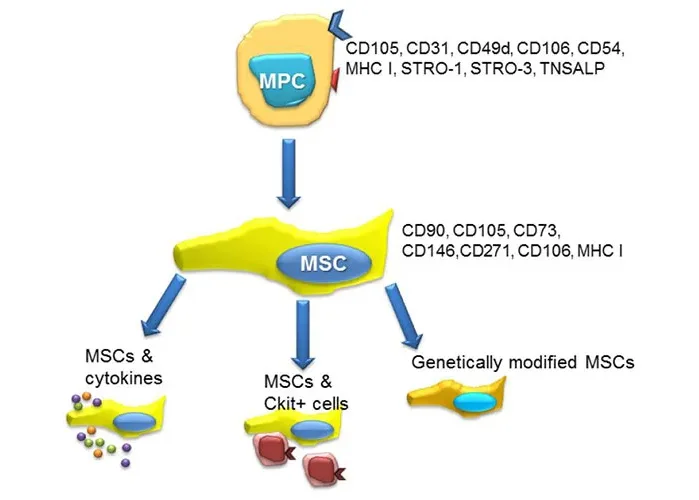
The evolution of MSC therapy for cardiac disease MSCs will play the central role in combination therapies supporting and orchestrating different cell types. Cytokines may also be given with or pretreat the target organ before MSC transplantation. A more challenging but promising way is the genetic modification of MSCs. (Circ Res. Author manuscript; available in PMC 2016 Apr 10.Published in final edited form as:Circ Res. 2015 Apr 10; 116(8): 1413–1430.)
 MakeWebEasy